
Travis Kalanick's Post-Uber Ventures
What happens after you get fired from the company you built, sued by your investors, and blacklisted from tech events?

Hello again.
As a reminder, I’m Chris Bakke, a founder, investor, and someone who’s been wondering what the hell Travis Kalanick has been doing since 2017.
In 2017, Travis got booted from Uber by his board after a series of scandals. He sold nearly $900 million in Uber stock. And then he kind of... disappeared for a while?
Well, not really. He just got really, really quiet.
So, I decided to dig into what Travis has been building since leaving Uber. Turns out… a lot.
It’s weirder (and more ambitious) than you’d think.
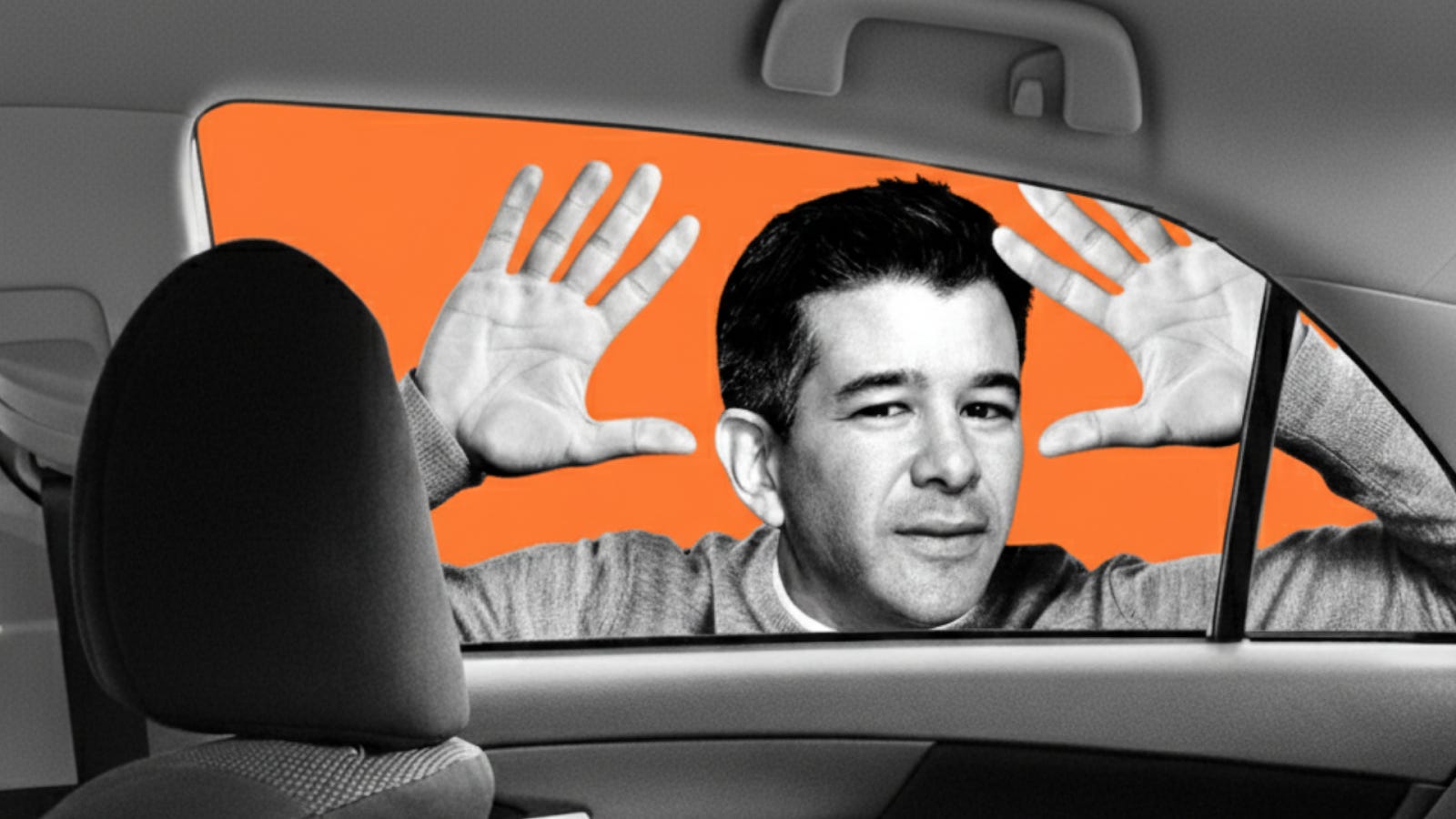
$150M Real-Estate-as-a-Platform:

In 2018, Travis made his first major post-Uber move. He dropped $150 million of his own money to acquire a controlling stake in City Storage Systems. If you’ve never heard of City Storage Systems, that’s the point. The concept was simple: buy distressed real estate (parking garages, shuttered restaurants, underutilized commercial spaces) and convert them into something more profitable.
City Storage Systems wasn’t consumer-facing. It was a platform that others would pay to access.
The thesis was pure Kalanick; find something inefficient, apply technology and operational intensity and create leverage. It became the foundation for everything else Travis built afterward. It’s the boring part of the empire that makes all the interesting parts possible as it continues to power his two core businesses, CloudKitchens and Otter (more on them below).
$15B Ghost Kitchen Empire:
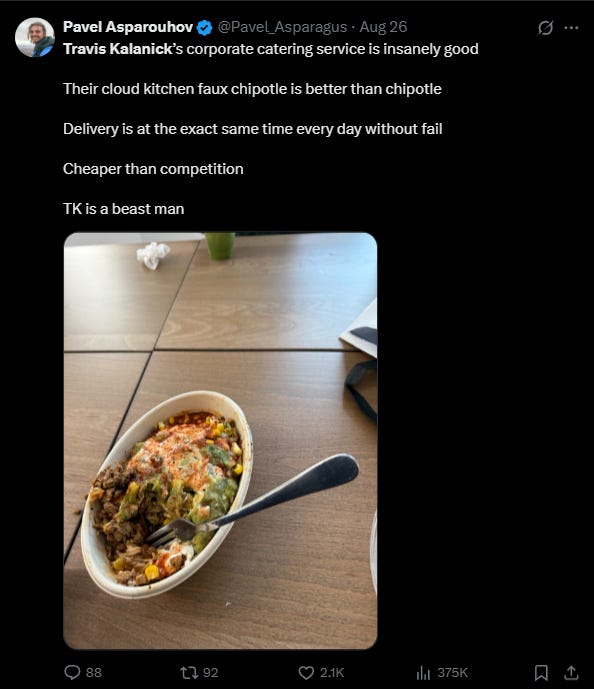
CloudKitchens is what happens when you take City Storage Systems’ real estate and turn it into delivery-only kitchen facilities. No dining rooms. No waiters. Just industrial kitchens pumping out DoorDash, Uber Eats, and Grubhub orders.
By 2021, CloudKitchens hit a $15 billion valuation. Their B2B food delivery operations platform Otter handles 18% of all U.S. food delivery transactions. In 2019, CloudKitchens secured $400M from Saudi Arabia’s PIF (the same sovereign wealth fund that invested billions in Uber during Travis’s tenure).
CloudKitchens operates with extraordinary secrecy. Employees sign NDAs before job interviews. In 2024, a former employee filed a sexual harassment lawsuit alleging a “boys’ club” culture reminiscent of Uber. Multiple tenants sued for deceptive practices. Reports show 65%+ tenant churn within a year. But despite all this, CloudKitchens keeps expanding. As of 2025, it operates 400+ locations across 110 cities in 30 countries.
The Stealth Venture Fund:
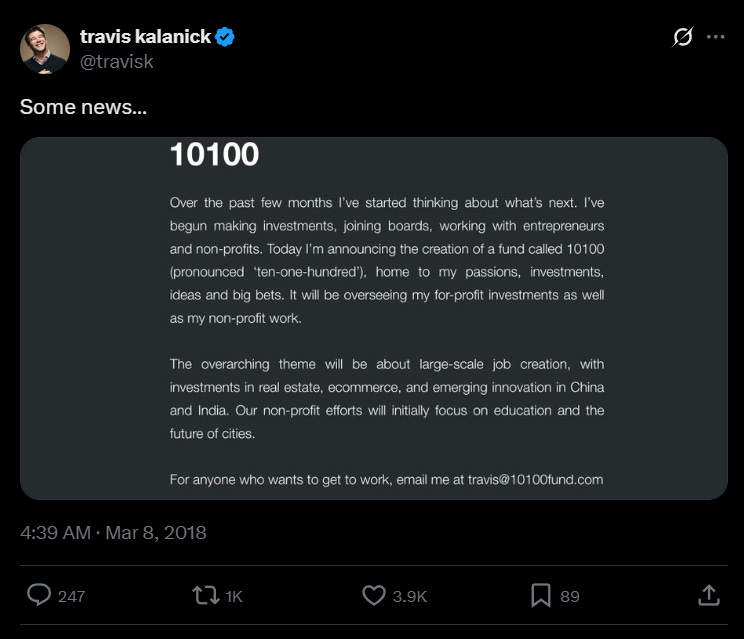
Somewhere between building CloudKitchens and not returning journalists’ calls, Travis also started a venture fund called 10100 (pronounced ‘ten-one-hundred’).
10100 focuses on real estate, e-commerce, and emerging tech companies in China and India, alongside non-profit work in education. The fund invested in at least four companies, one of which even went public in 2020 (home-selling platform Opendoor).
The fund operated with minimal public information. No flashy announcements. No press tours. No LP letters mysteriously leaked to TechCrunch. It was strategic, infrastructure-focused, and determinedly private. It hunted for platforms that powered commerce, logistics, and automation in markets where infrastructure is still being built.
But based on their site re-directing to a weird landing page, it seems pretty defunct as of today.
The Self-Driving Redemption Arc
Uber is now in talks with Travis to help fund his bid to acquire Pony.ai‘s (a Chinese self-driving car company) U.S. subsidiary. For Uber, these talks reflect serious competition from Waymo and growing fears about Tesla, which just launched its robo-taxi service in Austin.
For Pony.ai (which trades on the Nasdaq), it reflects how national security rules have forced it to keep its U.S. and Chinese businesses separate, setting the stage for this sale. Travis has maintained that Uber would have a self-driving fleet if he’d remained in charge.
When Uber went public in 2019, new CEO Dara Khosrowshahi rejected Travis’s request to stand on the NYSE balcony to help ring the opening bell. Still one of the lamest moves of all time.
But if this deal goes through, Travis gets to build the autonomous vehicle network he always wanted. With Uber’s help. After Uber fired him and abandoned self-driving themselves. You can’t make this stuff up.
Wrapping Up
Travis Kalanick has spent the last 8 years building a multi-billion dollar empire while staying almost completely out of the press. He’s created an infrastructure play in distressed real estate, turned it into a $15B ghost kitchen network operating 400+ locations across 110 cities, launched a stealth venture fund with a bunch of strategic investments, and is now allegedly trying to buy a autonomous car company with the help of the same company that booted him out.
I wouldn’t bet against him. The guy is relentless. Possibly unhinged. A bit controversial. But relentless. And that’s usually enough.
Until next time,
Chris
-
Questions? Feedback? Want to argue about whether ghost kitchens are killing restaurants or saving them?
Just reply to this email.
P.S. If you’re a founder working on content strategy, GTM, or just trying to figure out how to scale, we should talk.
My ghostwriting company Napa helps startups and founders build content engines that actually drive revenue.
Sign up to learn more here or schedule time with our team.
Hooray, my favorite twitter VC comedian is on substack! Looking forward to more of your takes on how to make children millionaires through lemonade stands, and traumatize them at the same time.